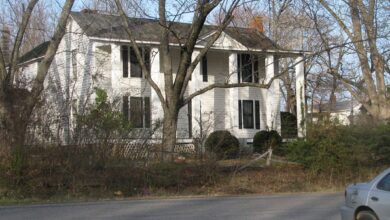
The Story of Critz, Virginia
Critz, Virginia, is a small rural community in Patrick County whose history reaches back more than two centuries. Although it is easy today to think of Critz as a quiet crossroads community in the foothills of the Blue Ridge, its past includes Revolutionary War veterans, tobacco farming and manufacturing, the rise of the Reynolds family, a railroad that connected the community to larger markets, and the gradual changes that affected many rural Southern communities after World War II.
Critz developed in the eighteenth century, when European settlers moved into the region that would eventually become Patrick County. One of the important early families was the Critz family. Local historical sources identify Hamon (or Haman) Critz, a German immigrant and Revolutionary War veteran, as the man for whom the community was named. Hamon Critz served during the American Revolution and is buried at Critz Baptist Church Cemetery. Virginia records identify him as a captain in the Henry County militia.
At the time of the earliest settlement, Patrick County did not yet exist. The area was originally part of larger counties, including Henry County. Patrick County was created from Henry County in the early 1790s. Its settlers were predominantly English and Scotch-Irish, although families such as the Critzes reflected the broader European immigration that shaped the region.
For much of the nineteenth century, Critz was primarily an agricultural community. Farms, small mills, stores and churches formed the basic structure of local life. Tobacco became especially important. Patrick County’s mountainous and Piedmont terrain was well suited to diversified farming, and tobacco eventually became one of the region’s principal cash crops.
One of the most important families in the history of Critz was the Reynolds family. Hardin William Reynolds established what became known as Rock Spring Plantation near Critz. He built the present brick house beginning in 1843. His son, Richard Joshua Reynolds, was born there in 1850. R. J. Reynolds later founded the R. J. Reynolds Tobacco Company in Winston-Salem, North Carolina, becoming one of the most important figures in the American tobacco industry.
The Reynolds connection is particularly important because tobacco manufacturing was already taking place at Rock Spring before R. J. Reynolds left Virginia. The National Park Service’s documentation of the property notes that the homestead included a store and tobacco factory. R. J. Reynolds learned the manufacture of chewing tobacco there as a young man.
The Reynolds Homestead remains the most prominent historic site associated with Critz. The house was restored in the twentieth century and is now operated as a Virginia Tech outreach and cultural center. It was listed on the National Register of Historic Places in 1971 and designated a National Historic Landmark in 1977. The Virginia Department of Historic Resources describes the property as an important example of an antebellum Greek Revival plantation house and emphasizes its connection with R. J. Reynolds and the development of the tobacco industry.
The nineteenth century also brought the Civil War and Reconstruction to Critz. Like other communities in Patrick County, Critz was part of a rural society profoundly affected by the war and by the abolition of slavery. Surviving Critz family papers include correspondence, land records, tobacco accounts and documents relating to enslaved people, providing evidence of the economic and social system in which local families lived.
A major change came late in the nineteenth century with the arrival of the Danville & Western Railway, popularly known as the “Dick & Willie.” The railroad was built through Critz around 1891. For a community that had previously been relatively isolated, the railroad provided a direct connection with places such as Stuart, Martinsville and Danville. It made it easier to move farm products and other goods and helped Critz develop into a more active commercial community.
The railroad era was an important period in Critz’s history. Stores and other businesses developed around the community, and Critz became more than simply a collection of farms scattered along rural roads. The railroad provided residents with transportation and created a connection with the larger regional economy.
One example of this period was Bahnson Franklin “Bonce” Martin, a prominent local businessman. Around 1908 Martin acquired substantial property in Critz and developed several business interests, including a dry-goods store, a candy factory and a petroleum-distribution business. His family also became closely connected to the Critz family through his marriage to Nannie Ware Critz. Martin died tragically in 1928 when his automobile was struck by a train.
The railroad eventually disappeared, however. Passenger and freight service through Critz continued into the twentieth century, but changing transportation patterns and the effects of World War II eventually brought an end to railroad service. According to a Virginia Tech historical study of Critz, service beyond Fieldale, including Critz, ended in 1942 because of wartime steel shortages and the relatively small population served by the line.
The loss of the railroad had consequences that extended well beyond transportation. After World War II, automobiles and highways became increasingly important, while many small rural businesses found it harder to survive. Agriculture also changed. Farms became more mechanized, and many families moved toward manufacturing or employment outside the immediate community. Virginia Tech describes Critz as having once been a bustling railroad community whose businesses declined after the trains stopped running.
Yet Critz did not disappear. Its residents maintained strong family and community connections, and the community’s historic buildings and institutions remained reminders of its earlier importance. The Reynolds Homestead became an especially important link between the past and the present, continuing to provide educational and cultural programs.
Today, Critz is a small unincorporated community, but its history is considerably larger than its present population might suggest. The community is part of the continuing effort to preserve Patrick County’s rural heritage. Recent plans for a Critz community center and park, developed with Virginia Tech and local residents, deliberately incorporate the area’s history into plans for its future. In September 2026, the Virginia Outdoors Foundation announced a $91,272 grant to help advance the proposed community center and park, including trails and educational signage interpreting Critz’s history.
Critz therefore represents an interesting piece of Virginia history. Its story began with eighteenth-century settlement and families such as the Critzes, grew through agriculture and tobacco, became connected to national economic development through the Reynolds family, and entered the modern era through the railroad and changing patterns of transportation and industry. Its decline as a commercial railroad community did not erase its identity. Instead, Critz remains a place where the history of rural Virginia can still be seen in its families, historic properties, roads, churches and landscape.
Perhaps the most significant aspect of Critz’s history is that it was never simply an isolated rural village. It was connected, at different times, to the American Revolution, the Civil War and Reconstruction, the tobacco industry, the railroad age, and the economic changes that transformed rural America after World War II. The surviving landmarks—especially the Reynolds Homestead—make that larger history unusually visible in a community of Critz’s size.